
RADIOHEAD
Oxford's finest have consistently made record company executives look foolish by pushing back the boundaries and still selling shedloads of records. Douglas Noble casts an expert eye over their constantly evolving songwriting DNA…
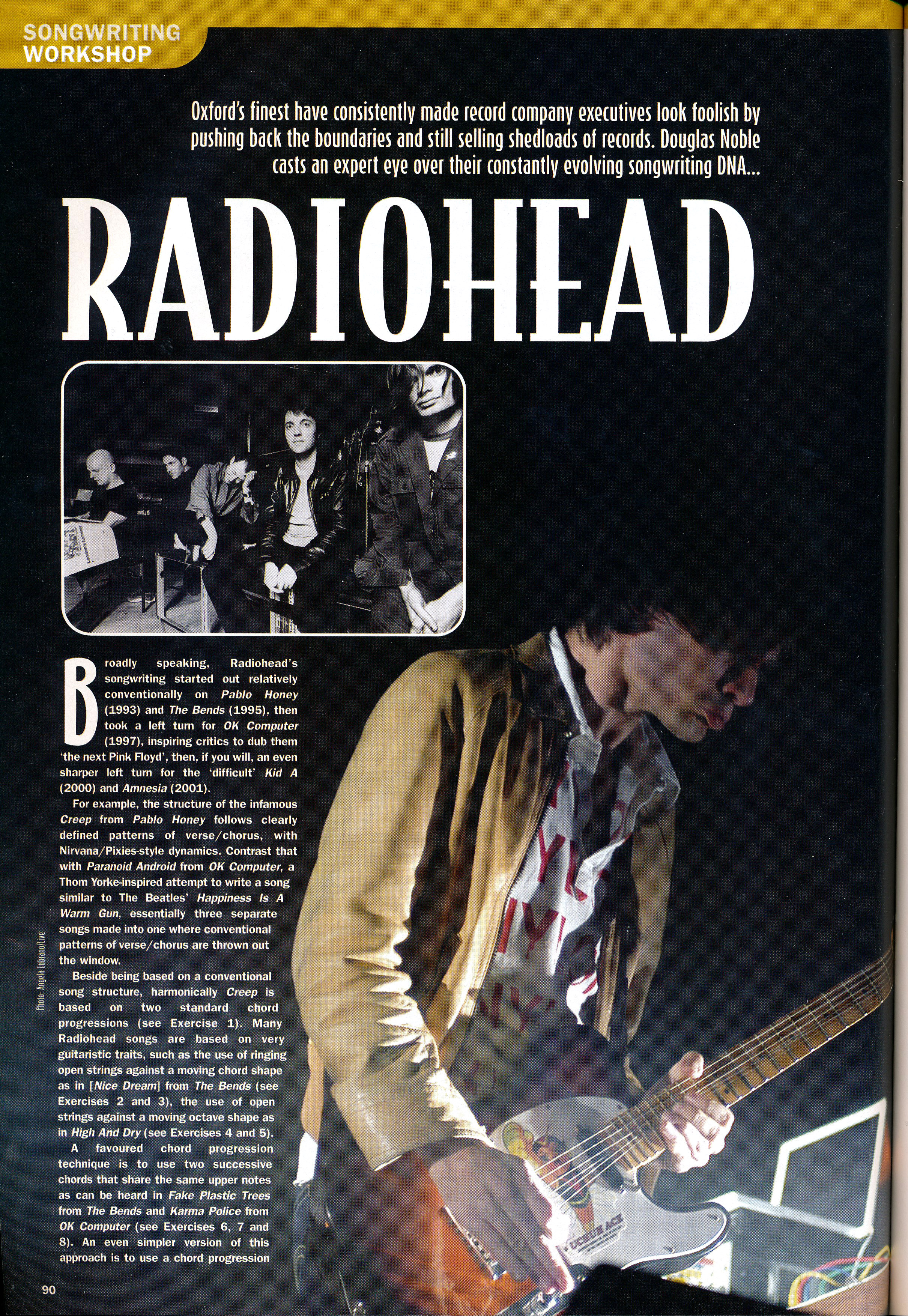
Broadly speaking, Radiohead’s songwriting started out relatively conventionally on Pablo Honey (1993) and The Bends (1995), then took a left turn for OK Computer (1997), inspiring critics to dub them ‘the next Pink Floyd’, then, if you will, an even sharper left turn for the ‘difficult’ Kid A (2000) and Amnesia (2001).
For example, the structure of the infamous Creep from Pablo Honey follows clearly defined patterns of verse/chorus, with Nirvana/Pixies-style dynamics. Contrast that with Paranoid Android from OK Computer, a Thom Yorke-inspired attempt to write a song similar to The Beatles’ Happiness Is A Warm Gun, essentially three separate songs made into one where conventional patterns of verse/chorus are thrown out the window.
Beside being based on a conventional song structure, harmonically Creep is based on two standard chord progressions (see Exercise 1). Many Radiohead songs are based on very guitaristic traits, such as the use of ringing open strings against a moving chord shape as in [Nice Dream] from The Bends (see Exercises 2 and 3), the use of open strings against a moving octave shape as in High And Dry (see Exercises 4 and 5).
A favoured chord progression technique is to use two successive chords that share the same upper notes as can be heard in Fake Plastic Trees from The Bends and Karma Police from OK Computer (see Exercises 6, 7 and 8). An even simpler version of this approach is to use a chord progression in which only one note is altered from one chord to the next, as can be heard in the haunting arpeggiated intro of Street Spirit (Fade Out) (see Exercises 9 and 10). As Radiohead’s songwriting has evolved they have incorporated unusual or changing time signatures into their music, as can be heard in the intro of Go To Sleep from Hail To The Thief (2003), again with a moving chord shape played against open strings (see exercises 11 and 12).
Whilst, along with Ed O’Brien, vocalist Thom Yorke forms part of Radiohead’s guitar armoury, it's difficult to overestimate the highly inventive contributions of guitarist Jonny Greenwood - the man who added the ultra distorted ‘kkk kkks' to Creep in an apparent attempt to destroy the song since he didn’t like it! It's not often you get a diminished scale in a rock song, but Greenwood adds an ascending tremolo picked diminished scale to the beginning of Just from The Bends (see Exercise 13). Despite this penchant for the obscure - he even plays a transistor radio in Climbing Up The Walls from OK Computer - Greenwood has also added some delightful touches to Radiohead songs, such as the highly melodic solo in High And Dry with its inventive use of unison E’s (although this part was actually written by Yorke).
Generally speaking, singer Thom Yorke brings ideas to the band who flesh them out, with songwriting credits being split between the five Radiohead members.
However, Radiohead have never been afraid to experiment in their songwriting and arrangements in ways that are impossible to tie down to musical exercises. Anyone Can Play Guitar begins with 17 seconds of random improvisation; in an attempt to live up to the song's title, the album’s producer, the studio owner, and the cook, joined in with the band in playing guitar - anything they wanted to do. Each separate part was given a track on the recording.
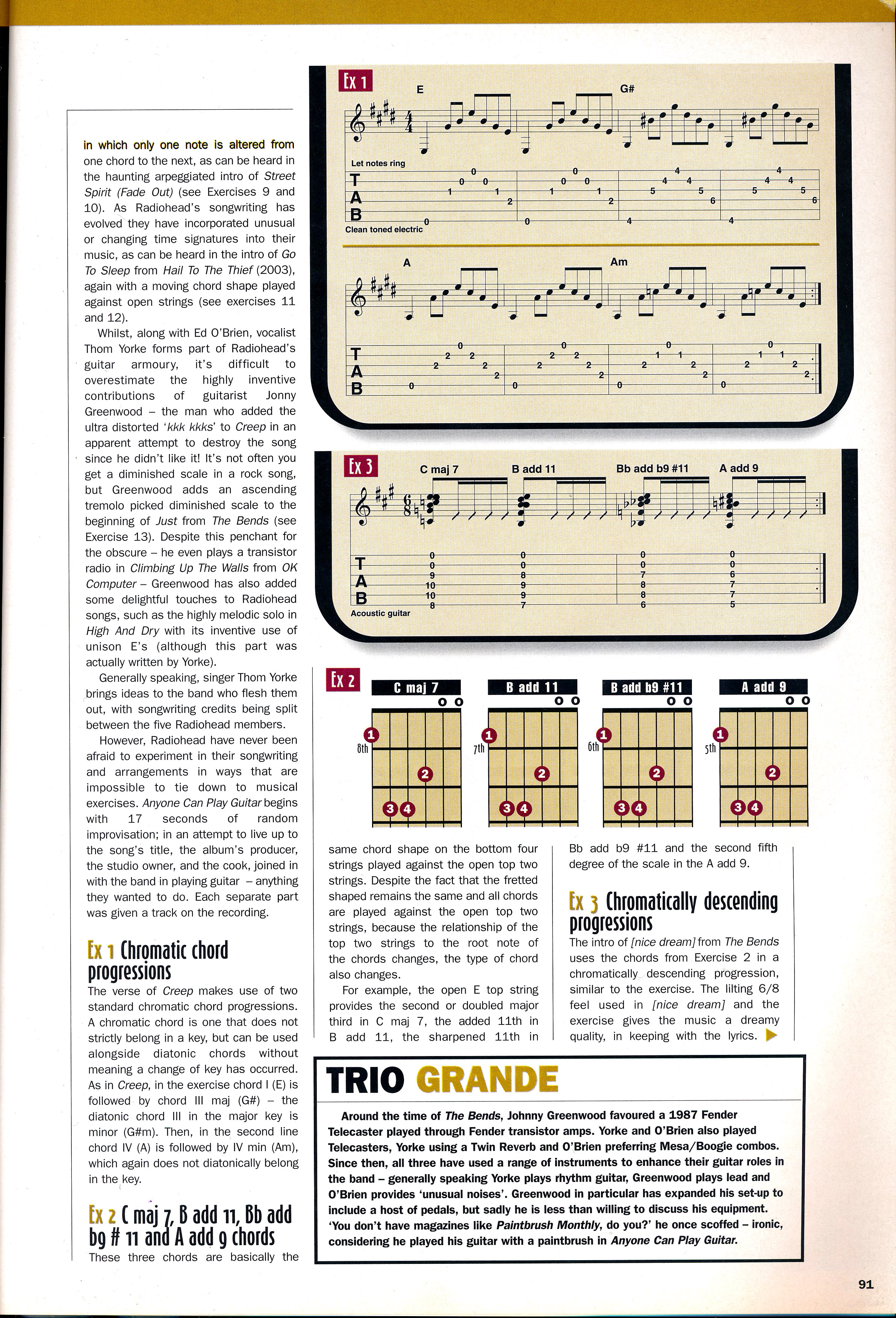
Ex 1 Chromatic chord progressions
The verse of Creep makes use of two standard chromatic chord progressions. A chromatic chord is one that does not strictly belong in a key, but can be used alongside diatonic chords without meaning a change of key has occurred. As in Creep, in the exercise chord I (E) is followed by chord IlI maj (G#) - the diatonic chord IlI in the major key is minor (G#m). Then, in the second line chord IV (A) is followed by IV min (Am), which again does not diatonically belong in the key.
Ex 2 C maj 7, B add 11, Bb add b9 # 11 and A add 9 chord
These three chords are basically the same chord shape on the bottom four strings played against the open top two strings. Despite the fact that the fretted shaped remains the same and all chords are played against the open top two strings, because the relationship of the top two strings to the root note of the chords changes, the type of chord also changes. For example, the open E top string provides the second or doubled major third in C maj 7, the added 11th in B add 11, the sharpened 11th in Bb add b9 #11 and the second fifth degree of the scale in the A add 9.
Ex 3 Chromatically descending progressions
The intro of [Nice Dream] from The Bends uses the chords from Exercise 2 in a chromatically descending progression, similar to the exercise. The lilting 6/8 feel used in [Nice Dream] and the exercise gives the music a dreamy quality, in keeping with the lyrics. The slash notation shows the rhythm to strum the chords in. Strum using alternate pick strokes for a smooth feel.
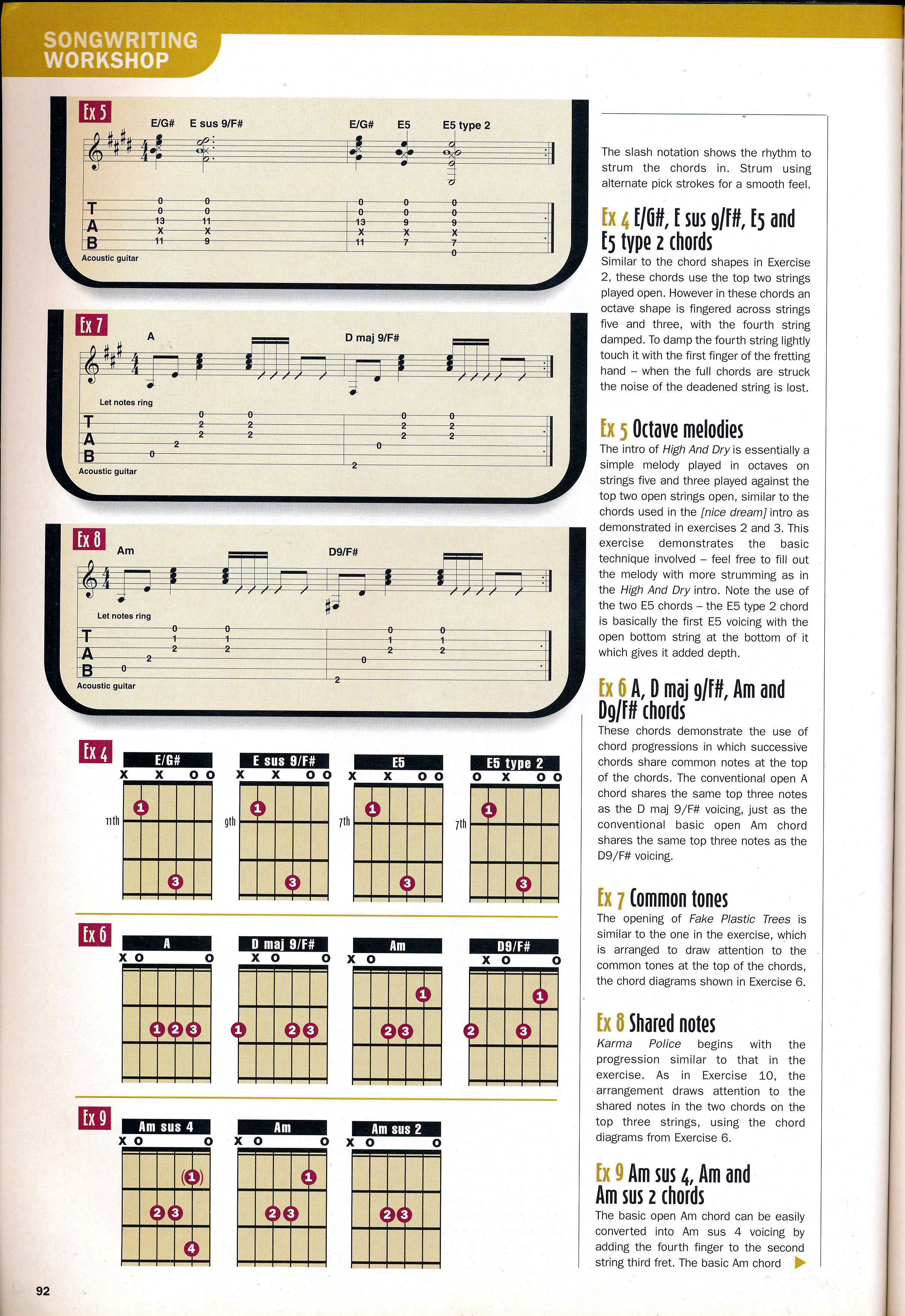
Ex 4 E/G#, E sus 9/F#, E5 and E5 type 2 chords
Similar to the chord shapes in Exercise 2, these chords use the top two strings played open. However in these chords an octave shape is fingered across strings five and three, with the fourth string damped. To damp the fourth string lightly touch it with the first finger of the fretting hand - when the full chords are struck the noise of the deadened string is lost.
Ex 5 Octave melodies
The intro of High And Dry is essentially a simple melody played in octaves on strings five and three played against the top two open strings open, similar to the chords used in the [Nice Dream] intro as demonstrated in exercises 2 and 3. This exercise demonstrates the basic technique involved - feel free to fill out the melody with more strumming as in the High And Dry intro. Note the use of the two E5 chords - the E5 type 2 chord is basically the first E5 voicing with the open bottom string at the bottom of it which gives it added depth.
Ex 6 A, D maj 9/F#, Am and D9/F# chords
These chords demonstrate the use of chord progressions in which successive chords share common notes at the top of the chords. The conventional open A chord shares the same top three notes as the D maj 9/F# voicing, just as the conventional basic open Am chord shares the same top three notes as the D9/F# voicing.
Ex 7 Common tones
The opening of Fake Plastic Trees is similar to the one in the exercise, which is arranged to draw attention to the common tones at the top of the chords, the chord diagrams shown in Exercise 6.
Ex 8 Shared notes
Karma Police begins with the progression similar to that in the exercise. As in Exercise 10, the arrangement draws attention to the shared notes in the two chords on the top three strings, using the chord diagrams from Exercise 6.
Ex 9 Am sus 4, Am and Am sus 2 chords
The basic open Am chord can be easily converted into Am sus 4 voicing by adding the fourth finger to the second string third fret. The basic Am chord can also be converted to the Am sus 2 chord by lifting the first finger from the second string.
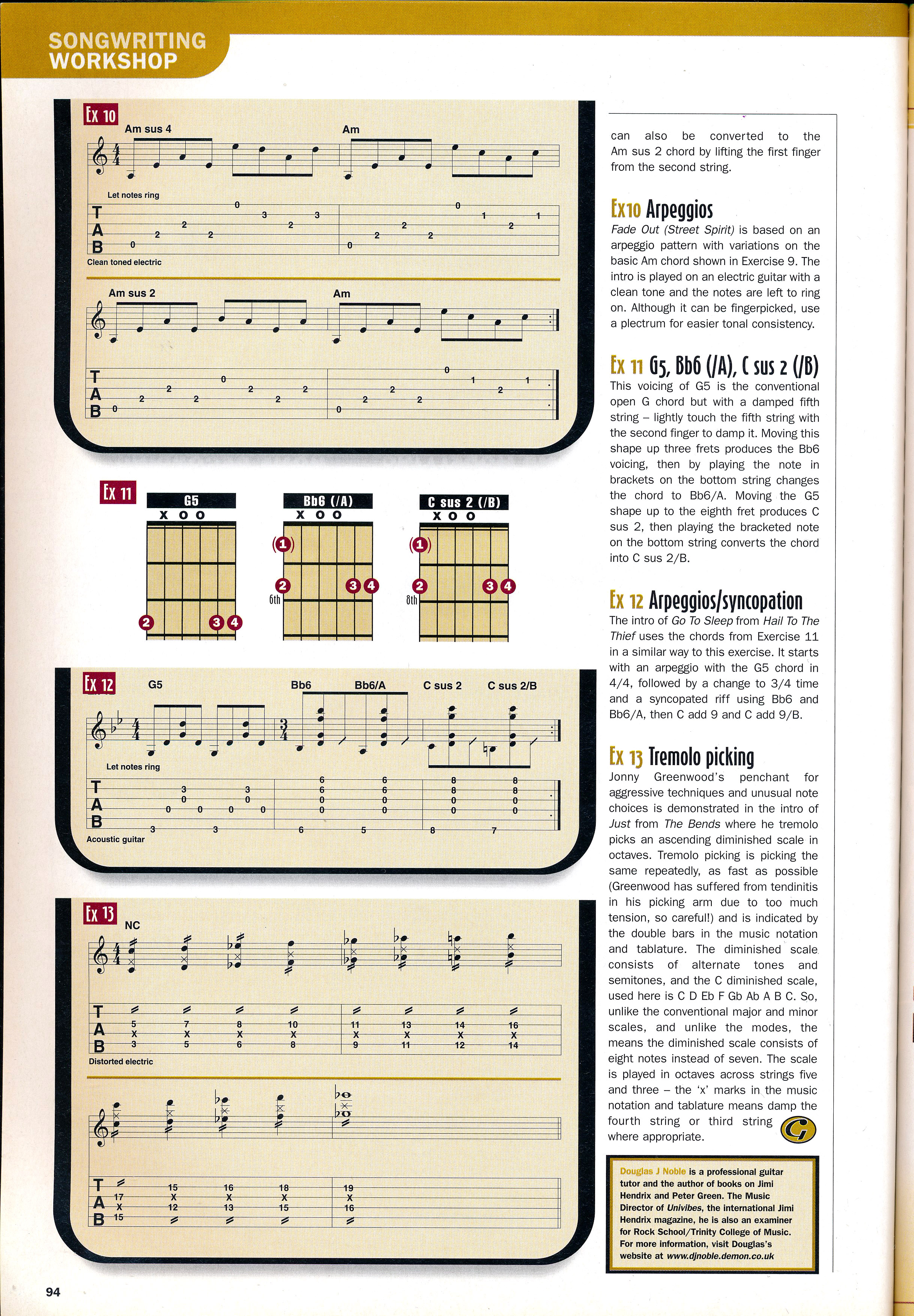
Ex 10 Arpeggios
Fade Out (Street Spirit) is based on an arpeggio pattern with variations on the basic Am chord shown in Exercise 9. The intro is played on an electric guitar with a clean tone and the notes are left to ring on. Although it can be fingerpicked, use a plectrum for easier tonal consistency.
Ex 11 G5, Bb6 (/A), C sus 2 (/B)
This voicing of G5 is the conventional open G chord but with a damped fifth string - lightly touch the fifth string with the second finger to damp it. Moving this shape up three frets produces the Bb6 voicing, then by playing the note in brackets on the bottom string changes the chord to Bb6/A. Moving the G5 shape up to the eighth fret produces C sus 2, then playing the bracketed note on the bottom string converts the chord into C sus 2/B.
Ex 12 Arpeggios/syncopation
The intro of Go To Sleep from Hail To The Thief uses the chords from Exercise 11 in a similar way to this exercise. It starts with an arpeggio with the G5 chord in 4/4, followed by a change to 3/4 time and a syncopated riff using Bb6 and Bb6/A, then C add 9 and C add 9/B.
Ex 13 Tremolo picking
Jonny Greenwood’s penchant for aggressive techniques and unusual note choices is demonstrated in the intro of Just from The Bends where he tremolo picks an ascending diminished scale in octaves. Tremolo picking is picking the same repeatedly, as fast as possible (Greenwood has suffered from tendinitis in his picking arm due to too much tension, so careful!) and is indicated by the double bars in the music notation and tablature. The diminished scale consists of alternate tones and semitones, and the C diminished scale, used here is C D Eb F Gb Ab A B C. So, unlike the conventional major and minor scales, and unlike the modes, the diminished scale consists of eight notes instead of seven. The scale is played in octaves across strings five and three - the ‘X’ marks in the music notation and tablature means damp the fourth string or third string where appropriate.
TRIO GRANDE
Around the time of The Bends, Jonny Greenwood favoured a 1987 Fender Telecaster played through Fender transistor amps. Yorke and O’Brien also played Telecasters, Yorke using a Twin Reverb and O’Brien preferring Mesa/Boogie combos. Since then, all three have used a range of instruments to enhance their guitar roles in the band - generally speaking Yorke plays rhythm guitar, Greenwood plays lead and O’Brien provides ‘unusual noises’. Greenwood in particular has expanded his set-up to include a host of pedals, but sadly he is less than willing to discuss his equipment. ‘You don’t have magazines like Paintbrush Monthly, do you?’ he once scoffed - ironic, considering he played his guitar with a paintbrush in Anyone Can Play Guitar.
Douglas J Noble is a professional guitar tutor and the author of books on Jimi Hendrix and Peter Green. The Music Director of Univibes, the international Jimi Hendrix magazine, he is also an examiner of Rock School/Trinity College of Music. For more information, visit Douglas’s website at www.djnoble.demon.co.uk