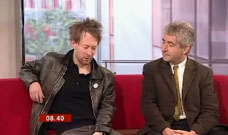
FEMALE ANCHOR: Well today Friends of the Earth is launching a new campaign to persuade the government to bring in a law to help reduce greenhouse gasses. Well helping raise awareness is the singer Thom Yorke from the rock band Radiohead. He's here with along with the charity's director Tony Juniper. Good morning to both you.
Thom: Good morning
Tony: Good morning
FA: Bit of a change for you, Thom, from Radiohead to Friends of the Earth, saving the world?
Thom: Saving the world?
Tony: Yeah. Well. We've got a day, haven't we?
Thom: Right, we'll finish about 6:00 this evening.
FA: What made you decide to get involved?
Thom: Um, this is an issue that's becoming basically more and more urgent, the science is less and less disputed, well there basically is no doubt now basically it's too terrifying -- I find it too terrifying not to get involved, um, and this is a way personally for me to direct my fear. (laughs)
Tony: -- and get people to do something positive --
Thom: Yes basically, and uh, I think Friends of the Earth basically has come up with the 3% reduction of carbon emissions year on year, basically the only sane solution to a problem that is too difficult to comprehend.
MALE ANCHOR: I mean, Tony Juniper, I want to ask you about this because you want this compulsory, you want this in law, because the government has targets, has existing targets for carbon reduction. Why do you want to see a legal basis for this?
Tony: Well as Thom says the science is moved on now so there' s no doubt that the science is real, it's caused by people, and it's a major problem, and science tells us that if we want to avoid the worst effects of this we have to take action now, and it's very good that the government has set targets into the future, some of them quite close into the future, but the reality is the targets are not being met, and as the time goes by the carbon emission in the country are going up again, we've got huge emissions expected in the future to rise as aviation takes off as traffic continues to grow, as we continue to burn coal, but fortunately there are some very positive solutions out there which can lead to these year on year targets being met, 3% reductions being met, through change in the way we generate power, the ways we use it, altering, changing the way we use transport, all these things can be very good for the economy, can help save the environment, and generate jobs too, so there's a lot of wins there to be found, and by setting a framework that is compulsory, rather than leaving it some voluntary action at some point in the future that may not happen, but making it a law, that all governments to follow, then something will happen. And that's why we're public to join in, and people can go to thebigask.com where they can get more information about the campaign.
MA: -- is the name of the campaign.
Tony: The campaign is called the Big AsK. As-K.
MA: …the 'k' very clearly.
Tony: Yes, the 'k'.
FA: Thom, I mean, you know we talk about it very often on 'Breakfast,' actually --
Thom: Do you?
FA: -- all these problems, and government initiatives and all the rest of it, the problem is, it's actually the infrastructure doesn't actually exist in this country, does it, to help people recycle, I mean that is [crosstalk]
Thom: I don't -- well, no, what you actually have to remember about the actual proportions of emissions and so on, is that basically a law needs to be put in place first, that makes carbon emission an issue, and the personal things that you and I need to do are important, but are not as important as for example decommissioning all the old coal-fired power stations they should have decommissioned 10 years ago. Basically there is a series of very, very large villains the government knows about, and that need to be dealt with, and basically a personal witch hunt against people saying, "You aren't doing enough, you aren't good enough." If there's not a legal framework, a legal structure, that so everybody knows where they stand, this is an issue, and if that is put in place, that sort of hysteria and panic will go away, and that sense of powerlessness will go away. And this is you know another reason I got involved, is that sort of... there's nothing you can do about it
MA: It's interesting, that sense of powerlessness, because a lot people will say, "I recycle in the limited way that my council allows me to, I don't drive a car very often, and I use public transport --
Thom: Well, that's right.
MA: -- it's not much else that --
Thom: No!
MA: -- I'm allowed to...
Tony: Well, what we find in our campaigns, that people are willing to join in, if only it's made easy, they can see that everybody's got an opportunity to make a difference, and that it's fair. And you know if somebody's taking a real sacrifice themselves but sees everybody else continuing to drive their 4x4's and wasting energy they feel a bit powerless, so if you get the government to start setting the framework so these things can be taken forward as a whole society, because climate change will affect the whole of society and not just now, but into the future and if we don't do something now, then the effects on our children and out grandchildren could quite simply be catastrophic the stakes are far to high for use to be leaving this to voluntary action and leaving it down to individuals, and so if people go to thebigask.com people can get really active, and as well as doing your recycling and saving a bit of energy, sign on to the website, get the news mail updates, by email, and lobby your MP --
Thom: Hassle your MPs, yeah.
Tony: And we can get there, we can make this happen and setting the framework, it's really positive. This is not a campaign about sacrifice; it's about changing things in a way that everyone will benefit.
Thom: 3% a year is not a major deal, and basically if we don't do the 3% a year, you'll leave it until it's too late.
FA: OK. Points powerfully made. Thank you very much indeed for coming to talk to use about that.
Thom: Pleasure.
Tony: Thank you so much.
BBC 'Breakfast News', may 25th 2005
[Interview with Thom]
.