

Inside The Mind Of Radiohead's Mad Genius!
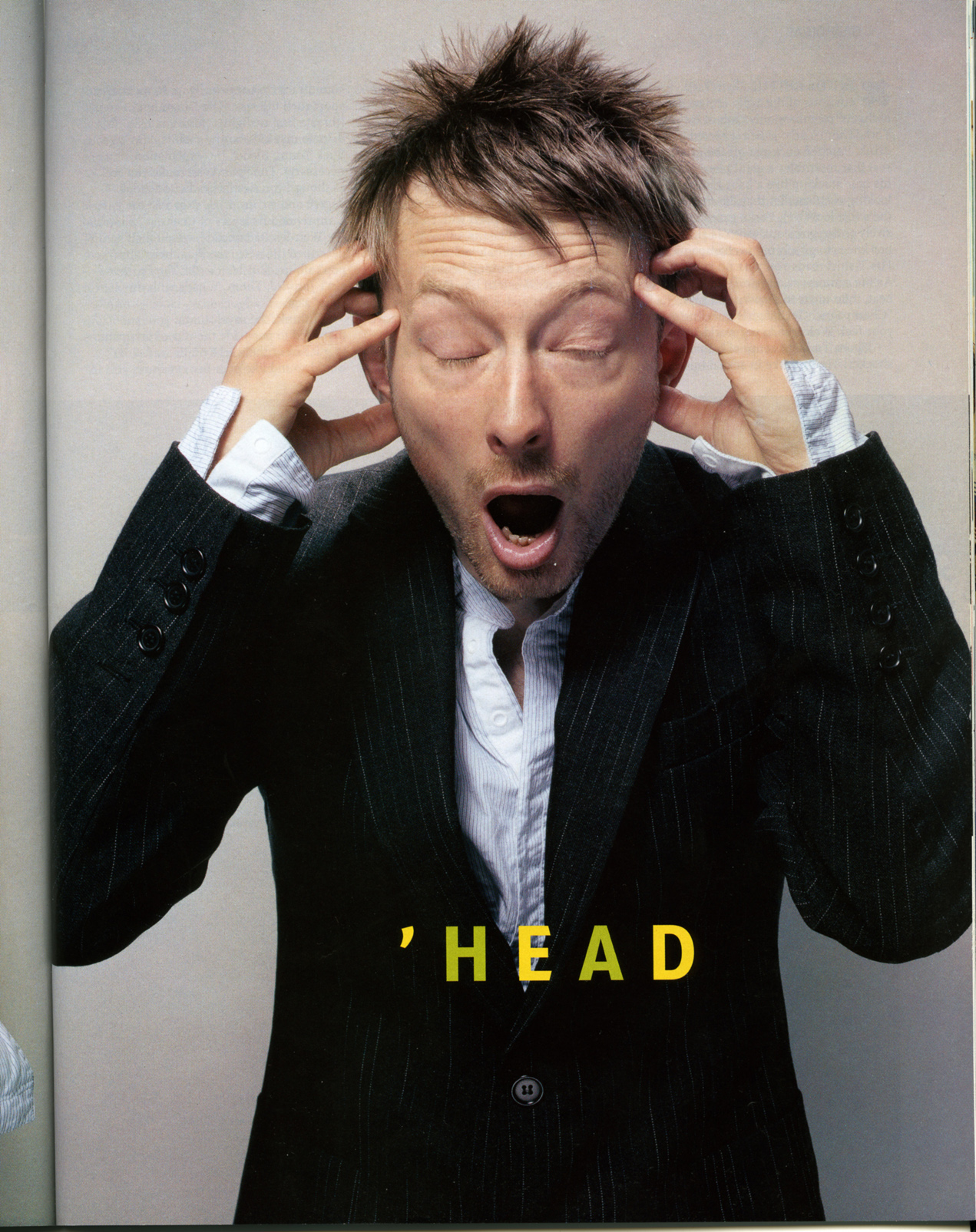
IN THE ARTFUL, distressed environs of the Soho House, an exclusive members-only club in New York, Thom Yorke is being served a drink. Perched on a just-off-the-ground seat that resembles a giant piece of candy, his hair stuck up like a baby bird’s, looking even smaller than he usually does (he’s five-foot-five), Yorke gazes impassively as the gorgeous waitress sinks to her knees to give him his champagne. His T-shirt reads YOU WILL DO FOR NOW. As the waitress sashays off, Yorke waits a beat, then turns to Blender and says, “Champagne. Geisha girls kneeling at your feet. Welcome to my world.”
Thom Yorke in sense-of-humor shocker! Thom Yorke in sexual-innuendo horror! Surely the earnest, highbrow lead singer of Radiohead is above such base wisecracks. We have been told, for 10 long years, that he and his band are serious. No jokes allowed.
The collegiate five-piece from Oxford, England, makes sounds that range from thundering guitar to free-form jazz to synthesized blips, topped with songs that speak of frustrated hearts, of paranoid minds, of anti-corporate politics and the soul-horror that’s lurking beneath contemporary Western life. Funny: no. Sexy: uh-uh.
Not that Yorke’s quip is representative of a change of musical direction. Radiohead’s new LP, Hail to the Thief, their sixth album, is hardly the soundtrack to American Pie 3. Its 14 tracks sport such titles as “The Gloaming” (threatening twilight), “Myxomatosis” (a disease that kills bunny rabbits) and “We Suck Young Blood” (no explanation necessary). The record can make you feel as though you need a graduate-school degree and a copy of No Logo just to comprehend its layers of unease.
Weirdly, Radiohead have publicly described the new record as their “shiny pop” album. But Hail to the Thief sure ain’t Justified, Thom. What’s with the “pop” tag?
“I think,” he says, “that if you managed to persuade the record company to put any of the tracks on the radio, it would sound like pop. But everyone thinks of us as an albums band and listens to the record all in one go. People scrutinize it so closely. I have so had enough of this! No one gives that much of a shit.”
But with Radiohead, they do.
“I know,” Yorke admits, “and that alarms me. We take our music seriously, but not as seriously as people think. Things like ‘We Suck Young Blood,’ with that fast bit on the piano, it’s ridiculous — you can’t get chin-scratchy about that. It makes me laugh.”
And — look! — he laughs. Yorke’s music may not always be upbeat, but he’s enjoying himself.
“Yeah, I’m happy,” he says convivially. “At this precise moment, anyway. Someone has given us money to stick the phrase hail to the thief on walls all around the world. That made me chuckle for ages.” He raises his bubbling glass. “Cheers.”
IT’S 2003, AND RADIOHEAD are comfortable in their skin. “It’s taken us 10 years to do it, but we have finally moved away from the Method,” says guitarist Ed O’Brien. “We used to live the pain. Now we’ve made a dark record — but we’re OK.”
He smiles. We’re in Edinburgh, Scotland, a week earlier. Backstage after an emotional, intimate gig in front of 1,500 at the Corn Exchange, Radiohead are hosting a party for a select group of fans and friends. The small room is lit murkily by candles. There’s no background music and not much booze around, just a selection of bottles and cans on a buffet table. The event has more in common with an impoverished student’s birthday party than a multimillion-selling rock group’s after-show celebration.
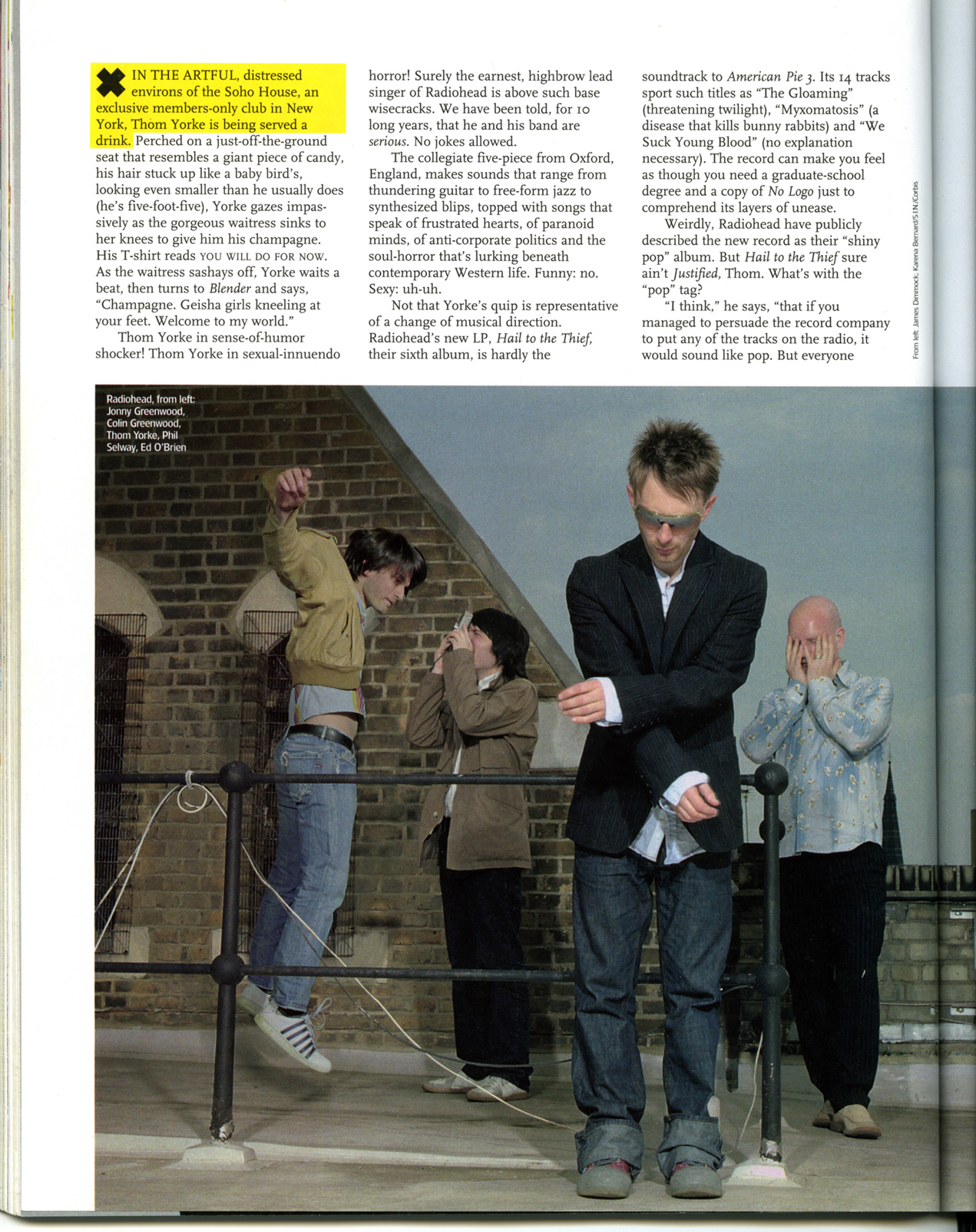
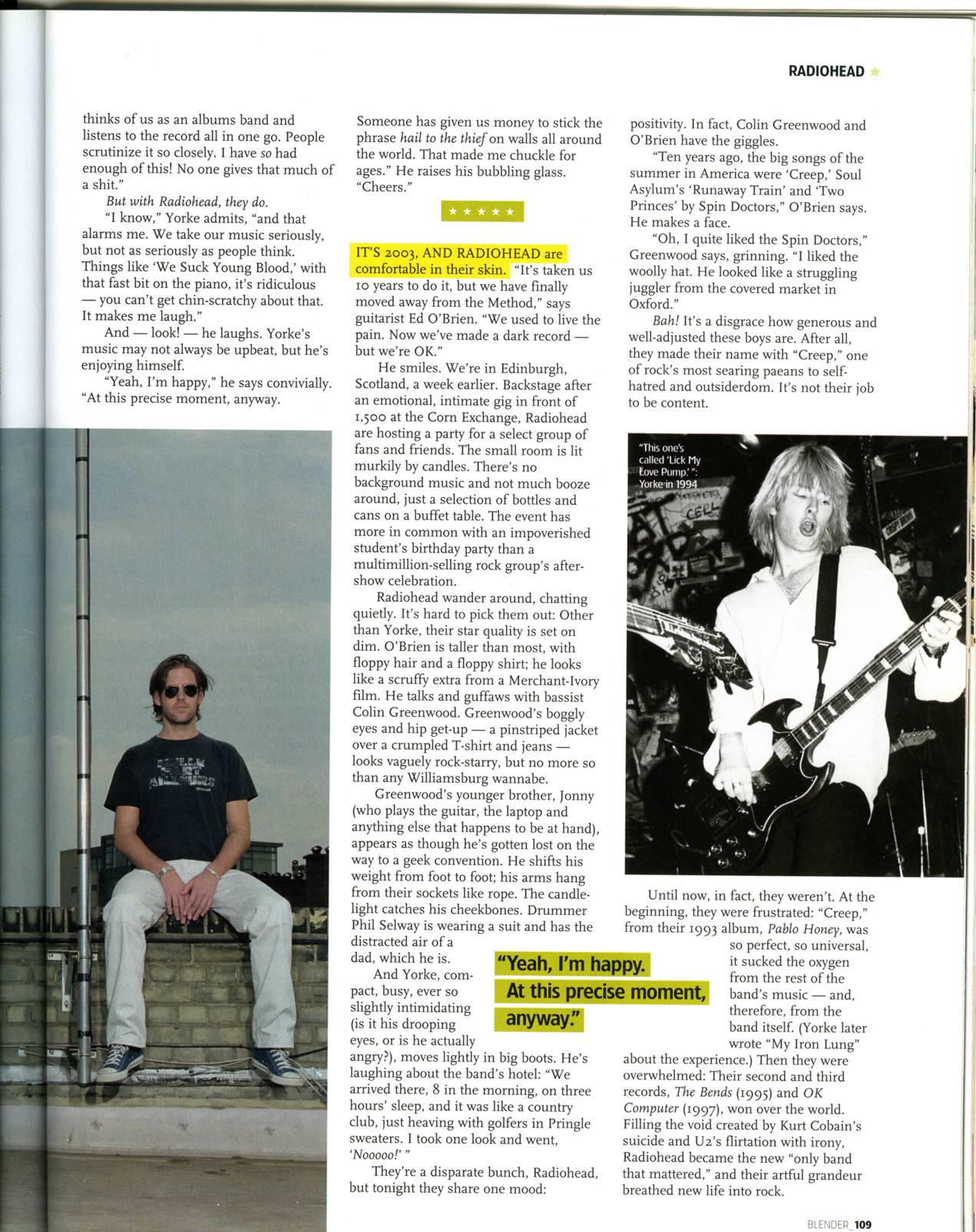
Radiohead wander around, chatting quietly. It’s hard to pick them out: Other than Yorke, their star quality is set on dim. O’Brien is taller than most, with floppy hair and a floppy shirt; he looks like a scruffy extra from a Merchant-Ivory film. He talks and guffaws with bassist Colin Greenwood. Greenwood’s boggly eyes and hip get-up — a pinstriped jacket over a crumpled T-shirt and jeans — looks vaguely rock-starry, but no more so than any Williamsburg wannabe.
Greenwood’s younger brother, Jonny (who plays the guitar, the laptop and anything else that happens to be at hand), appears as though he’s gotten lost on the way to a geek convention. He shifts his weight from foot to foot; his arms hang from their sockets like rope. The candlelight catches his cheekbones. Drummer Phil Selway is wearing a suit and has the distracted air of a dad, which he is.
And Yorke, compact, busy, ever so slightly intimidating (is it his drooping eyes, or is he actually angry?), moves lightly in big boots. He’s laughing about the band’s hotel: “We arrived there, 8 in the morning, on three hours’ sleep, and it was like a country club, just heaving with golfers in Pringle sweaters. I took one look and went, ‘Nooooo!’”
They’re a disparate bunch, Radiohead, but tonight they share one mood: positivity. In fact, Colin Greenwood and O’Brien have the giggles.
“Ten years ago, the big songs of the summer in America were ‘Creep,’ Soul Asylum’s ‘Runaway Train’ and ‘Two Princes’ by Spin Doctors,” O’Brien says. He makes a face.
“Oh, I quite liked the Spin Doctors,” Greenwood says, grinning. “I liked the woolly hat. He looked like a struggling juggler from the covered market in Oxford.”
Bah! It’s a disgrace how generous and well-adjusted these boys are. After all, they made their name with “Creep,” one of rock’s most searing paeans to self-hatred and outsiderdom. It’s not their job to be content.
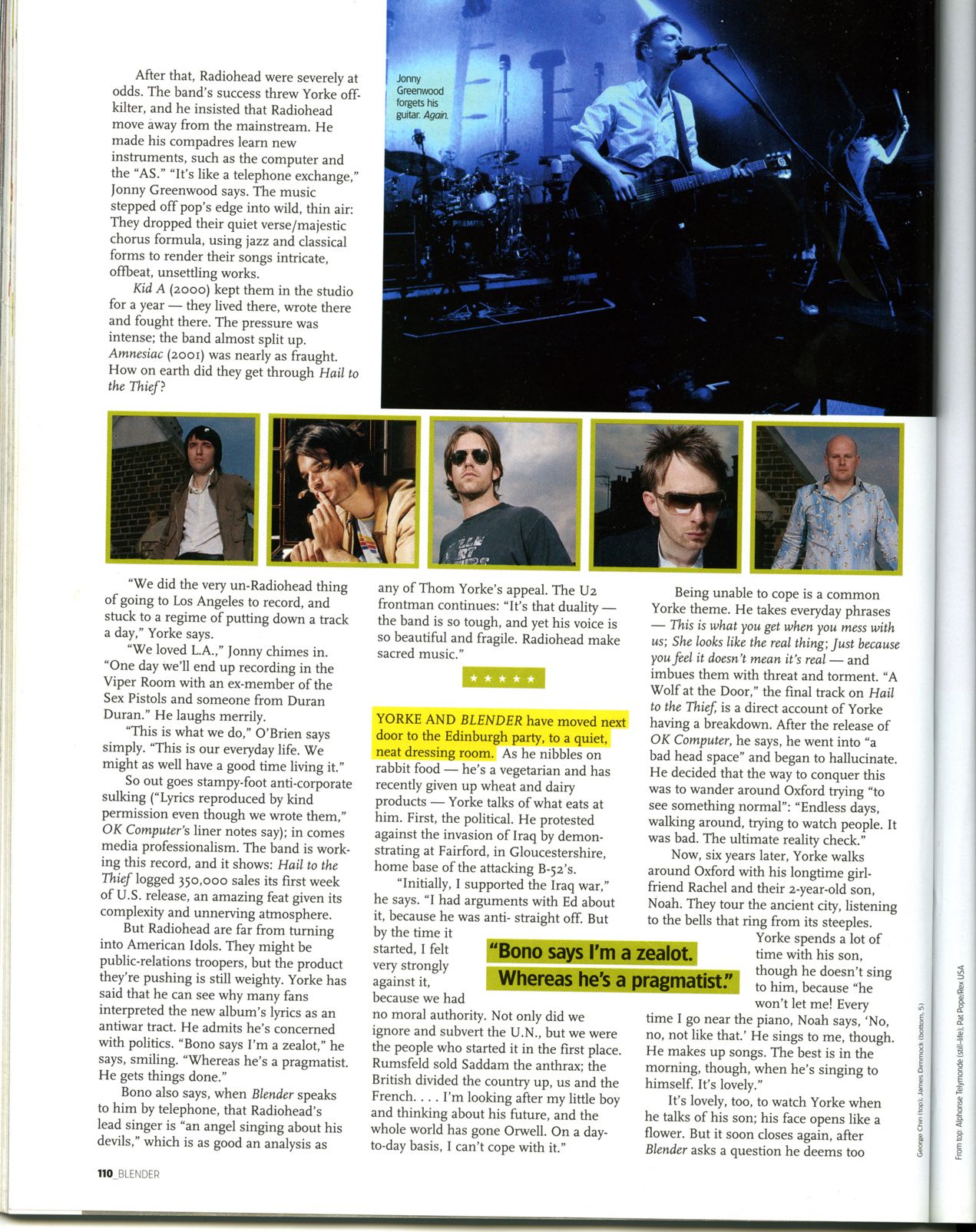
Until now, in fact, they weren’t. At the beginning, they were frustrated: “Creep,” from their 1993 album, Pablo Honey, was so perfect, so universal, it sucked the oxygen from the rest of the band’s music — and, therefore, from the band itself. (Yorke later wrote “My Iron Lung” about the experience.) Then they were overwhelmed: Their second and third records, The Bends (1995) and OK Computer (1997), won over the world. Filling the void created by Kurt Cobain’s suicide and U2’s flirtation with irony, Radiohead became the new “only band that mattered,” and their artful grandeur breathed new life into rock.
After that, Radiohead were severely at odds. The band’s success threw Yorke off-kilter, and he insisted that Radiohead move away from the mainstream. He made his compadres learn new instruments, such as the computer and the “AS.” “It’s like a telephone exchange,” Jonny Greenwood says. The music stepped off pop’s edge into wild, thin air: They dropped their quiet verse/majestic chorus formula, using jazz and classical forms to render their songs intricate, offbeat, unsettling works.
Kid A (2000) kept them in the studio for a year — they lived there, wrote there and fought there. The pressure was intense; the band almost split up. Amnesiac (2001) was nearly as fraught. How on earth did they get through Hail to the Thief?
“We did the very un-Radiohead thing of going to Los Angeles to record, and stuck to a regime of putting down a track a day,” Yorke says.
“We loved L.A.,” Jonny chimes in. “One day we’ll end up recording in the Viper Room with an ex-member of the Sex Pistols and someone from Duran Duran.” He laughs merrily.
“This is what we do,” O’Brien says simply. “This is our everyday life. We might as well have a good time living it.”
So out goes stampy-foot anti-corporate sulking (“Lyrics reproduced by kind permission even though we wrote them,” OK Computer’s liner notes say); in comes media professionalism. The band is working this record, and it shows: Hail to the Thief logged 350,000 sales its first week of U.S. release, an amazing feat given its complexity and unnerving atmosphere.
But Radiohead are far from turning into American Idols. They might be public-relations troopers, but the product they’re pushing is still weighty. Yorke has said that he can see why many fans interpreted the new album’s lyrics as an antiwar tract. He admits he’s concerned with politics. “Bono says I’m a zealot,” he says, smiling. “Whereas he’s a pragmatist. He gets things done.”
Bono also says, when Blender speaks to him by telephone, that Radiohead’s lead singer is “an angel singing about his devils,” which is as good an analysis as any of Thom Yorke’s appeal. The U2 frontman continues: “It’s that duality — the band is so tough, and yet his voice is so beautiful and fragile. Radiohead make sacred music.”
YORKE AND BLENDER have moved next door to the Edinburgh party, to a quiet, neat dressing room. As he nibbles on rabbit food — he’s a vegetarian and has recently given up wheat and dairy products — Yorke talks of what eats at him. First, the political. He protested against the invasion of Iraq by demonstrating at Fairford, in Gloucestershire, home base of the attacking B-52’s.
“Initially, I supported the Iraq war,” he says. “I had arguments with Ed about it, because he was anti- straight off. But by the time it started, I felt very strongly against it, because we had no moral authority. Not only did we ignore and subvert the U.N., but we were the people who started it in the first place. Rumsfeld sold Saddam the anthrax; the British divided the country up, us and the French…. I’m looking after my little boy and thinking about his future, and the whole world has gone Orwell. On a day-to-day basis, I can’t cope with it.”
Being unable to cope is a common Yorke theme. He takes everyday phrases — This is what you get when you mess with us; She looks like the real thing; Just because you feel it doesn’t mean it’s real — and imbues them with threat and torment. “A Wolf at the Door,” the final track on Hail to the Thief, is a direct account of Yorke having a breakdown. After the release of OK Computer, he says, he went into “a bad head space” and began to hallucinate. He decided that the way to conquer this was to wander around Oxford trying “to see something normal”: “Endless days, walking around, trying to watch people. It was bad. The ultimate reality check.”
Now, six years later, Yorke walks around Oxford with his longtime girlfriend Rachel and their 2-year-old son, Noah. They tour the ancient city, listening to the bells that ring from its steeples. Yorke spends a lot of time with his son, though he doesn’t sing to him, because “he won’t let me! Every time I go near the piano, Noah says, ‘No, no, not like that.’ He sings to me, though. He makes up songs. The best is in the morning, though, when he’s singing to himself. It’s lovely.”
It’s lovely, too, to watch Yorke when he talks of his son; his face opens like a flower. But it soon closes again, after Blender asks a question he deems too personal. Notoriously guarded about his private life, he stops talking, stops eating, twists his body into knots. In fact, he’s so paranoid about his privacy that it takes a few minutes for him to confirm his birthdate: October 7, 1968. He flatly refuses to give his retired parents’ names or disclose what they did for a living (though his father’s occupation is known; he was a chemical-equipment supplier).
“You’re not upsetting me,” he says. “But sometimes I come away from interviews feeling invaded. I’m working out if I’m going to feel invaded or not. And… yeah. I’m not answering that.” (This came in response to the question, Did you and your younger brother, Andrew, share a bedroom when you were small?)
Yorke is more forthcoming about himself than his loved ones. Blender learns that he wasn’t athletic when he was younger — not because he wasn’t in shape, but because of his droopy left eye: “I can’t judge distances. I can’t see a ball properly.” He was born with it completely shut, and had a series of operations to graft in muscle so it could open. He still can’t see perfectly: “I see best through a pinhole, which is useful.” He got accustomed to his eye when he was young, but it still gets him into trouble. If you sit to his left, as Blender is doing at the moment, it seems as though he is constantly throwing you baleful looks. “I know,” he protests. “I can’t go out on a Friday night, because I look at people in a certain way and they think I want a fight.”
Still, when he was young he could see well enough to ride a bike, and he was a good gymnast until his teenage years, when he took up smoking. He went to a public primary school, and then a private high school, Abingdon, along with the rest of Radiohead. His friends at home rejected him because he went there. “They blanked me out. I used to cycle around, and one of them once got his older brother to kick the shit out of me and throw me in the river, just because I’d gone to that school.”
Yorke first picked up a guitar when he was 7. He simply walked up to his music teacher and said he wanted to learn. “When I heard Queen for the first time, I went straight into school and told her, ‘I want to be Brian May. I’m going to be a rock star.’ She went, ‘Of course you are, dear.’ ” When he was a teenager, frustrated and unhappy in his new, tony school, he would draw pictures of how his future band would look — where the instruments would be onstage, what they would look like. It would be a four-piece.
So what happened to your vision?
“I met Colin.”
As 15-year-olds, Colin Greenwood and Yorke weren’t friends, but they crashed the same parties. Greenwood wore unitards and listened to Alien Sex Fiend; Yorke wore thrift-store suits that his mother altered to fit him. “We’d turn up at parties, and he’d be in a cat suit and I’d be in a sharp suit,” Yorke says. One time, with friends, they left a party drunk and decided to play chicken by lying in the middle of the road to see if cars would stop. The first vehicle that approached was a police car. They didn’t play again.
Yorke found the parties hard. He had hit puberty young, at 11, but Abingdon School was for boys only. “Going to single-sex schools is damaging, and it takes a long time to sort it out,” he says. “Because you want to get some action, and you can’t get any. And when you do, it’s fucked up. I used to go to these parties because I wanted to get into trouble and meet girls, and that’s where you go, but it’s such a ridiculously pressurized situation. I’d get [drunk] out of my mind and then take charge of the music: ‘Fuck the lot of you; we’re listening to Joy Division.’”
Their love of Joy Division united Radiohead, along with their worship of the Smiths and R.E.M. O’Brien was recruited because he looked like Morrissey. They stole Jonny Greenwood from Andrew Yorke’s band. Selway came along for the ride, and then there were five. They practiced in a sympathetic teacher’s music rooms.
But aside from the band, and art, which he enjoyed, Yorke’s school life went badly. He was unhappy and regularly picked on. “Certain people take great pleasure in making others’ lives misery. I’m not very tolerant with people like that. If someone pushed me too hard, I’d push them against the wall, threaten to break their skull — and mean it. I was definitely seen as a psycho.”
Yorke reached a crisis point at 16, when he was nearly kicked out of school. He decided to pull back, concentrate, get into art school. Which he did: He enrolled at Exeter University to study English literature and fine art. He came back to Oxford on weekends to practice with the band, and when college ended, his rock-star life began: Radiohead were signed almost immediately thereafter. Jonny Greenwood has been in the band since he was 14. All five know no other way of life. Thank goodness they’ve begun to enjoy it.
Yorke and Blender talk about art for a while. Perhaps as a result of his schooling, he has a healthy cynicism about it. “Nothing’s worth 10 thousand, 10 million…. I don’t buy art. I have got some prints. My favorite is of Millbank, the [British] Labour [Party] headquarters. It’s massive. It’s a beautiful black-and-white print, but also scary. The artist has fucked with it in some way. My girlfriend’s a printmaker as well, and it was someone she knew.”
What do you spend your money on, then, if not art?
“Well… I lost most of my money on a house. I had to rebuild it. It was a total nightmare. But that’s OK. That’s my problem. Silly me.”
Jonny Greenwood walks into the room, looking for a soda.
What do you think Thom will be like when he’s old, Jonny?
“He’ll be mental,” Jonny says without missing a beat as he opens the fridge.
“Of course I will! I’ll be pissing myself and shouting, relishing my deafness! ‘What?’”
Is there anything you’d like to achieve before getting to that exalted grumpy-old-man state, Thom?
He takes another bite of lettuce and has a bit of a think. He laughs again.
“You know, Radiohead isn’t a democracy. Most functioning democracies don’t function as a democracy. But I am built to listen to people. If somebody in the band says, ‘That’s not right,’ I’m not into it. Even if I was into it 100 percent before, I’m not until we’ve sorted it out. Which is why,” says Thom Yorke, benevolent dictator, bedeviled angel, happy worrier, “I’d make a really good president.”